
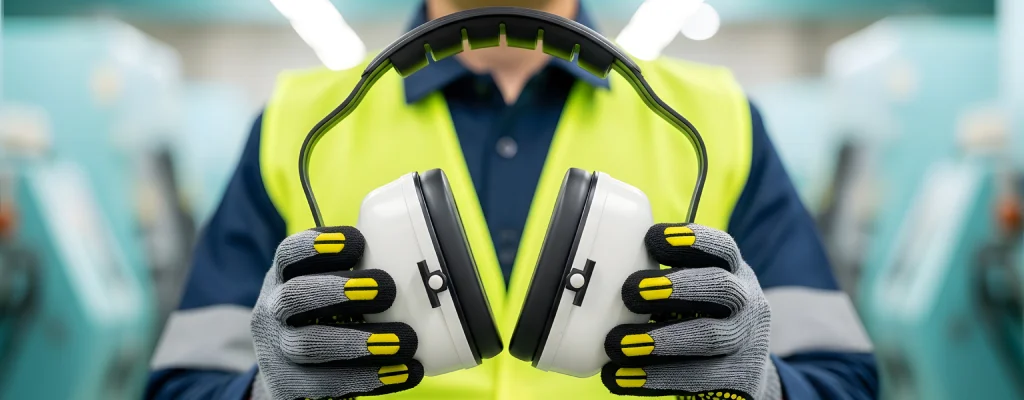
How to Choose the Right Hearing Protection at Work
Choosing the right hearing protection at work is not simply about buying the highest-rated ear plugs or ear defenders available.
Unfortunately, this is one of the most common mistakes we see during Noise at Work Assessments.
Many businesses know they have a noise issue, so they immediately look for hearing protection with the highest SNR rating they can find. While this may seem like the most protective option, it can actually create new safety risks by overprotecting employees.
Hearing protection should not simply block out as much sound as possible. It should reduce noise exposure to a safe level while still allowing employees to communicate, hear alarms, recognise warning signals and remain aware of their surroundings.
Why Hearing Protection at Work Can Be Too Strong
The SNR, or Single Number Rating, tells you how much sound reduction a hearing protector may provide under test conditions. For example, a pair of ear defenders with an SNR of 35 dB may appear to offer a very high level of protection.
However, higher does not always mean better.
If hearing protection reduces the sound level at the ear too far, workers may become isolated from their environment. This can cause issues such as:
- Difficulty hearing spoken instructions;
- Reduced awareness of moving vehicles, machinery or alarms;
- Employees removing hearing protection to communicate;
- A false sense of safety;
- Poor compliance because the protection feels impractical or uncomfortable.
The HSE also warns that hearing protection should not reduce the level at the ear too far, as overprotection can make communication more difficult and increase safety risks in the workplace.
This is known as overprotection.
In many workplaces, overprotection can be just as problematic as under-protection. If employees cannot hear what is going on around them, they may be exposed to other workplace hazards. If the hearing protection is too isolating, they may also be more likely to remove it during noisy tasks, which reduces its effectiveness.
The aim is not to make the workplace silent. The aim is to reduce noise exposure to an acceptable and safe level.
First, You Need to Know the Noise Levels
Before selecting hearing protection, you need to understand the actual noise levels within the workplace.
This means identifying:
- Which areas are noisy;
- Which tasks or tools create the highest noise levels;
- How long employees are exposed for;
- Whether exposure varies throughout the day;
- Whether there are peak noise risks;
- Which employees or job roles are most at risk.
Without this information, choosing hearing protection becomes guesswork.
For example, one area of a factory may require hearing protection, while another may not. One employee may only be exposed to high noise for a short period, while another may have regular exposure throughout the day. Some tasks may involve high-frequency noise, while others may contain more low-frequency noise.
This is why a Noise at Work Assessment is so important. It gives you the measured data needed to decide whether hearing protection is required, where it is required, and what level of protection is suitable.
A proper assessment will help you avoid both under-protecting and overprotecting your staff.
Hearing Protection Should Be a Last Resort
It is also important to remember that hearing protection is a form of personal protective equipment. Like all PPE, it should normally be considered a last resort.
Before relying on ear plugs or ear defenders, employers should first consider whether noise can be reduced at source.
This may include:
- Quieter machinery or tools;
- Maintenance of noisy equipment;
- Acoustic enclosures or barriers;
- Isolation of noisy processes;
- Changes to working methods;
- Reducing exposure time;
- Separating employees from noisy areas.
Hearing protection may still be required, but it should not be the first and only control measure. The best approach is to reduce noise as much as reasonably practicable before prescribing suitable hearing protection for any remaining risk.
How to Select Hearing Protection Using SNR
Suitable hearing protection at work should reduce exposure to a safe level without cutting employees off from important workplace sounds.
The SNR method is the simplest way to estimate the protection provided by hearing protection.
In basic terms:
Estimated level at the ear = measured noise level – SNR value
However, this is only a starting point.
The manufacturer’s SNR value is based on laboratory testing. In the real world, hearing protection is often less effective due to factors such as poor fitting, incorrect use, hair, glasses, hard hats, face shields, or other PPE affecting the seal.
For this reason, a Real World Factor should be deducted from the stated SNR.
As a general approach, the stated SNR should be reduced by 4 dB to allow for real-world use.
For example:
- Measured noise level: 95 dB(A)
- Hearing protection SNR: 25 dB
- Real World Factor deduction: 4 dB
- Adjusted protection: 21 dB
- Estimated level at the ear: 74 dB(A)
In this example, the hearing protection would reduce the employee’s exposure to a suitable protected level without unnecessarily overprotecting them.
However, if the same employee was given hearing protection with an SNR of 35 dB, the estimated level at the ear may be reduced too far. This could make communication difficult and increase the chance of the employee removing the protection during work.
How to Use the HML Method
The HML method is more detailed than the basic SNR method.
HML stands for:
- H – High-frequency attenuation;
- M – Medium-frequency attenuation;
- L – Low-frequency attenuation.
This method is useful because not all workplace noise has the same frequency content. Some noise sources are dominated by high-frequency sound, while others may contain more low-frequency energy.
For example, two pieces of equipment could both measure 95 dB(A), but one may have a very different sound character to the other. The same hearing protection may not perform equally well against both sources.
The HML method uses the measured noise levels and the H, M and L values provided by the hearing protection manufacturer to give a more accurate estimate of the protected level.
This is particularly useful where the noise has strong low-frequency content, as some hearing protection may not perform as effectively at lower frequencies.
How to Use Octave Band Data
The octave band method is more detailed again.
This method looks at the noise levels across individual frequency bands, rather than relying on one overall figure. The attenuation provided by the hearing protection is then assessed across those same frequency bands.
This can be especially useful where:
- The noise has a clear tonal character;
- There is strong low-frequency noise;
- Standard SNR selection may not be accurate enough;
- A more precise assessment of protected exposure is required;
- There is concern about either under-protection or overprotection.
Octave band analysis allows hearing protection to be selected more accurately for the actual noise source, rather than choosing a product based only on a single headline SNR figure.
What Protected Level Should Hearing Protection at Work Achieve?
In most cases, the aim should be to reduce the level at the ear to below 85 dB(A), while avoiding unnecessary overprotection.
A good practical target is often somewhere between 70 and 80 dB(A) at the ear.
If the protected level is still too high, the employee may remain at risk of noise-induced hearing damage. If the protected level is too low, communication and situational awareness may be affected.
This is why selecting hearing protection should be based on measured noise data, not guesswork or simply choosing the highest-rated product.
Common Mistakes When Choosing Hearing Protection
Some of the most common mistakes include:
- Choosing the highest SNR product without checking whether it is suitable;
- Using the same hearing protection across every area of the site;
- Not allowing for real-world performance;
- Ignoring compatibility with other PPE;
- Not training employees on how to fit and use protection correctly;
- Failing to check whether employees can still hear alarms or instructions;
- Treating hearing protection as the first control measure rather than the last resort.
The right hearing protection should be suitable for the noise risk, comfortable enough to wear properly, compatible with other PPE, and practical for the work being carried out.
Final Thoughts
Choosing hearing protection is not about finding the product with the biggest SNR rating. It is about selecting the right level of protection for the actual noise exposure.
Before prescribing hearing protection, employers should first understand the noise levels in the workplace, consider whether noise can be reduced at source, and then select suitable protection using measured data.
SNR can provide a useful starting point, but HML and octave band methods may be needed where a more detailed assessment is required. It is also important to allow for real-world factors, as hearing protection often performs differently on site than it does in laboratory testing.
The safest option is not always the strongest hearing protection. The safest option is the most suitable hearing protection.
A Noise at Work Assessment provides the measured data needed to choose appropriate hearing protection at work.